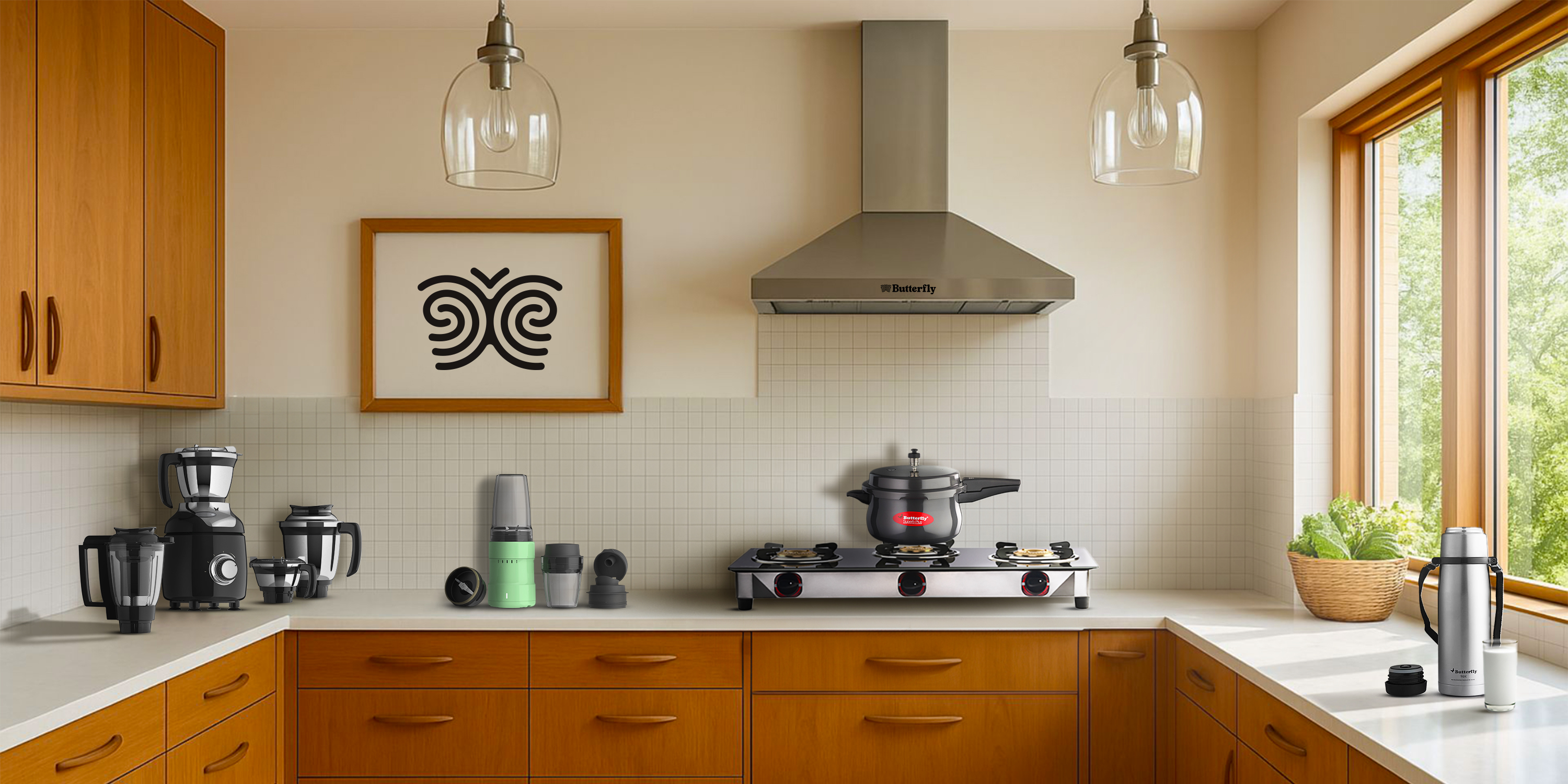
In the crowded world of Indian consumer brands, where multinational giants battle for shelf space and attention spans, few stories are as rooted, resilient, and distinctly Indian as that of Butterfly Gandhimathi Appliances Limited. For millions of households across South India, the Butterfly name is not merely a brand stamped on a kitchen appliance. It is a familiar presence in everyday life—a mixer grinder humming through the morning rush, a pressure cooker steaming on a family stove, or a wet grinder preparing batter for generations-old recipes. Over seven decades, Butterfly has become woven into the domestic fabric of South India, transforming itself from a modest utensil manufacturer into one of India’s most recognizable kitchen appliance companies. Today, Butterfly stands at a fascinating crossroads. With revenue touching approximately ₹943 crore in FY2025–26 and a market capitalization of around ₹1,163 crore, the company occupies a significant position in India’s fast-growing kitchen and home appliance sector. Its evolution entered a new phase when Crompton Greaves Consumer Electricals acquired a controlling stake and now holds nearly 75 percent ownership, providing the company with access to a larger national distribution ecosystem and stronger financial backing. Yet despite this transformation, Butterfly retains the identity that made it successful in the first place—a company built around understanding the needs of Indian kitchens better than almost anyone else. The importance of Butterfly lies not only in its financial performance but also in what it represents. It is a story about manufacturing, entrepreneurship, regional strength, and adaptation. It is a company that survived changing consumer preferences, economic shocks, technological disruptions, and fierce competition while remaining relevant to generations of consumers. In many ways, Butterfly mirrors the evolution of modern India itself—traditional in its roots, ambitious in its outlook, and constantly reinventing itself without abandoning its heritage.
Origin Story
The story begins not with a product launch or a venture capital cheque, but with a walk through a Coimbatore bazaar sometime in the 1950s. Late Shri V. Murugesa Chettiar came from a family of metal merchants whose roots stretched across trade routes that connected Vijayawada, Bombay, and Calcutta. His ancestors moved brassware — heavy, ornate, deeply embedded in the Indian domestic imagination. Brass vessels were not merely utensils; they were heirlooms. Every Indian kitchen that mattered had them. Murugesa Chettiar looked at this tradition and made a different bet. He watched stainless steel arrive in post-independence India — cheap to work with, rust-resistant, hygienic, and far more practical for daily use than polished brass — and he understood what most of his contemporaries did not: that the Indian kitchen was about to change. Not because of aspiration or status, but because of ordinary household economics. A stainless steel tumbler did not tarnish. It did not need polishing. It was affordable enough for any family, and it lasted. He made one. Then he made more. That simple stainless steel tumbler, produced in a small workshop in Coimbatore, was the first product of what would eventually become one of India’s most recognizable kitchen appliance brands. The founding philosophy was never about luxury. Murugesa Chettiar was not building for the upper-class household that already had everything. He was building for the ordinary Indian family — functional products, honest quality, accessible price. This positioning, which might seem modest or even unambitious to outsiders, turned out to be exactly the right one for a market that numbered in the hundreds of millions.
A stainless steel tumbler did not tarnish. It did not need polishing. It was affordable enough for any family, and it lasted.
The Founder and His Sons
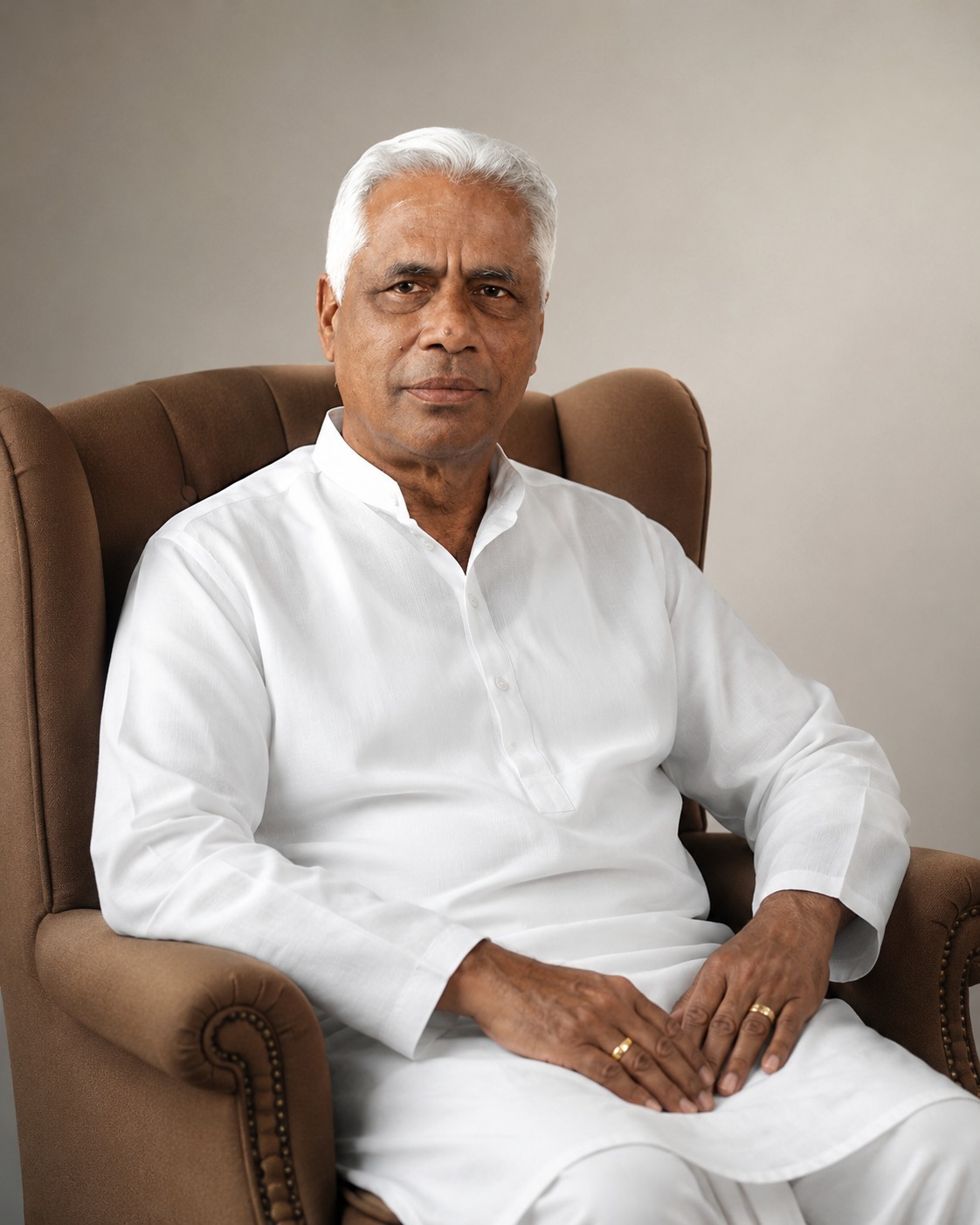
A legacy built on discipline, persistence and an intimate understanding of the Indian kitchen.
Late Shri V. Murugesa Chettiar belonged to a generation of entrepreneurs who built businesses through discipline, persistence, and an intimate understanding of customer needs. Colleagues and associates often described him as a businessman who paid extraordinary attention to product quality. He believed that trust was earned not through advertising slogans but through consistent performance. Every product that left the factory had to justify the confidence consumers placed in the Butterfly name. His leadership style reflected traditional business values. Integrity, reliability, and customer satisfaction were not corporate buzzwords but operating principles. These values shaped the culture of the organization and helped establish a reputation that would endure long after the founder’s lifetime.
As the business expanded, Murugesa Chettiar involved his five sons in building the enterprise. Sri V.M. Lakshminarayanan, Sri V.M. Kumaresan, Sri V.M. Seshadri, Sri V.M. Balasubramaniam, and Sri V.M. Gangadharam each played significant roles in scaling the company. Together, they transformed a family-run manufacturing operation into a diversified consumer appliance business capable of competing across multiple product categories.
The second generation brought professionalization, operational expansion, and strategic diversification. Manufacturing capacity increased, product portfolios broadened, and distribution networks grew deeper across South India. While each family member contributed in different ways, their collective effort ensured continuity between the founder’s vision and the company’s modern ambitions. Over time, Butterfly underwent another transformation. What had begun as a founder-led enterprise evolved into a family-managed company and eventually into a publicly listed organization governed by institutional standards. This transition required balancing entrepreneurial agility with professional management practices. Today, that legacy continues under the leadership of Chairman and Managing Director Mr. V.M. Lakshminarayanan, one of the key architects of Butterfly’s growth, alongside CEO Ms. Swetha G., who represents a newer generation of professional leadership. Their stewardship reflects the company’s ability to blend family values with contemporary business practices.
Board of Directors and Governance
A company’s governance structure is often the least interesting thing written about it, but in Butterfly’s case it is actually a useful lens. The board of 13 directors, seven of whom are independent — including one woman director — is formally compliant with SEBI LODR Regulations 2015. That compliance matters less as a regulatory checkbox than as evidence of a transformation. Butterfly spent most of its existence as a family-managed company where governance happened through relationships rather than structures. The arrival of Crompton Greaves as majority shareholder in 2022 changed this in ways that went beyond equity ownership. Crompton brought institutional governance norms, professional management expectations, and board composition requirements that pushed Butterfly toward genuine separation of ownership and oversight. The independent directors are not decorative. They represent a shift in how decisions get made and how accountability gets structured in a company that now has a national mandate rather than a regional one. From a family kitchen appliance maker to a professionally governed public company — the arc is clear, even if the transition is still ongoing.
Evolution
Seven Decades, Rewritten Repeatedly
To understand Butterfly’s present, it helps to understand how often the company was forced to reinvent itself. The 1950s and 1960s were years of building — stainless steel products made in Coimbatore for a South Indian market gradually converting from brass and copper. The 1970s were consolidation years, building trade relationships and expanding the product range. By the time Gandhimathi Appliances Limited was formally incorporated in 1986, the company had a clear identity as a South Indian kitchen specialist.
The founding bet. Stainless steel over brass. Without this decision, there is no Butterfly.
Formally incorporated as Gandhimathi Appliances Limited. Structure catches up with scale after three decades of organic growth.
Goes public. ISO 9001 certification. First in India with stainless steel pressure cookers and vacuum flasks. The brand earns national credibility
Green Label certification for high thermal efficiency LPG stoves — before energy efficiency was a fashionable concern for appliance makers.
₹745 crore in Tamil Nadu government orders across two years. Transformational revenue — but the dependency trap that caused the 2017 collapse was set right here
Net loss. The reckoning. Government orders gone, demonetisation hits. The company is forced to rebuild entirely on branded consumer sales. This is where modern Butterfly is actually born.
Crompton acquires 75%. Family majority ends. The regional brand formally becomes a national ambition.
Magnum Air Fryer, ₹943 crore revenue, CRISIL AA/Stable. Proof the rebuilding worked
Product Portfolio
The breadth of Butterfly’s product range tells its own story about ambition and market reading. The company’s core has always been the gas stove — both traditional LPG stoves and the glass-top variants that arrived with India’s urbanizing middle class. Butterfly holds the number one position in stainless steel LPG stoves in South India, a category it helped define. These are not premium lifestyle products. They are the kind of reliable, affordable cooking infrastructure that families buy once and expect to last. The mixer grinder and the table-top wet grinder are where Butterfly’s South Indian identity becomes most explicit. The wet grinder — essential for making idli and dosa batter — is a category that national brands never fully cracked, partly because they did not grow up understanding how seriously South Indian households take the quality of their batter. Butterfly grew up knowing exactly that. Its wet grinders, built around the specific grinding requirements of South Indian cooking, became the dominant choice in the region. This is not a trivial competitive advantage; it is the kind of category knowledge that cannot be acquired quickly. Pressure cookers, electric rice cookers, kitchen chimneys, non-stick cookware, stainless steel utensils, vacuum flasks, water bottles, breakfast appliances, iron boxes, air coolers, fans, and kettles complete a range that now covers virtually every corner of the modern Indian kitchen. The launch of the Magnum Air Fryer in August 2024 is particularly worth noting — it represents Butterfly’s move into the lifestyle and health-adjacent cooking segment, where urban Indian consumers are increasingly spending. An air fryer is a very different purchase from a pressure cooker. It says something about where Butterfly is trying to go.
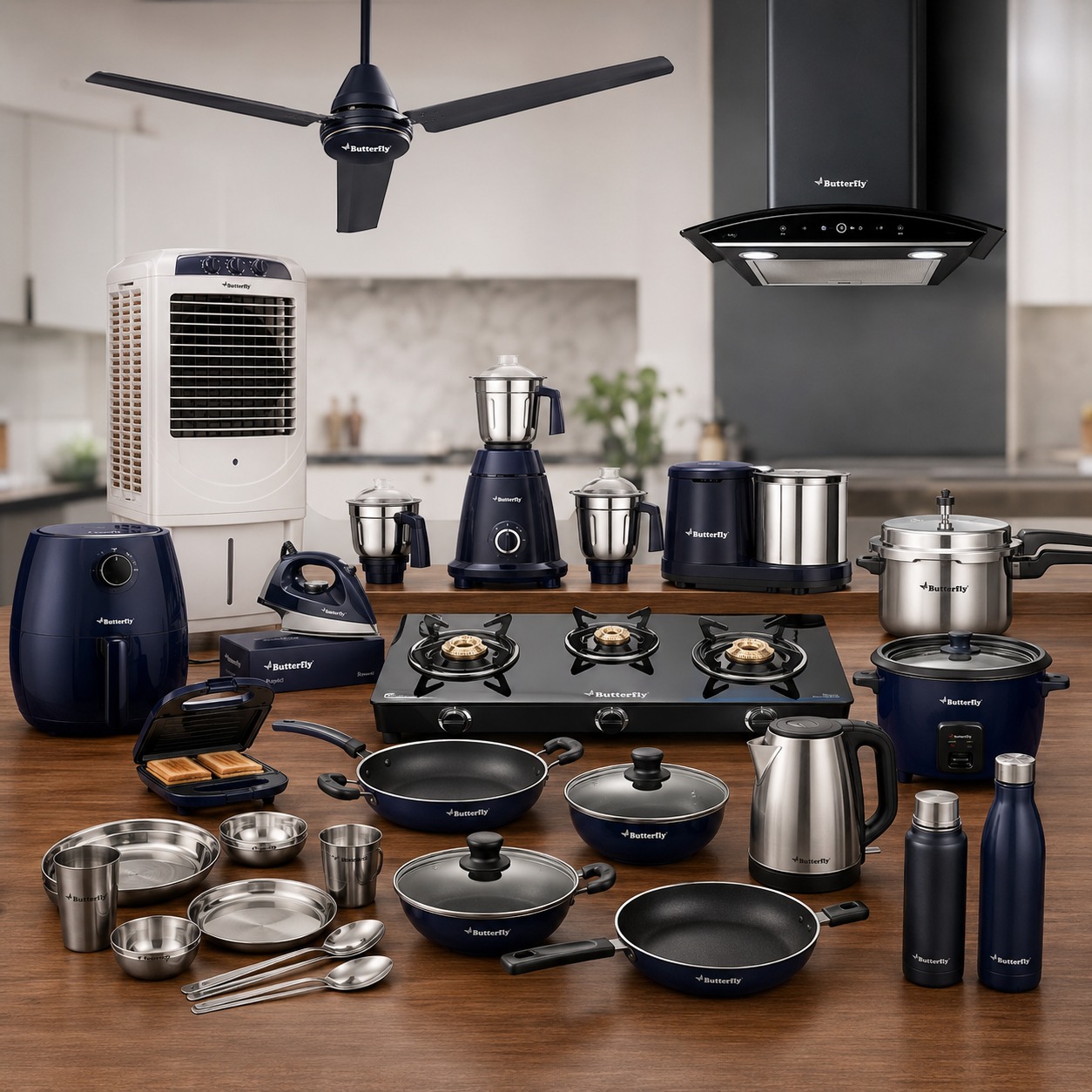
From gas stoves and wet grinders to air fryers — a range covering virtually every corner of the modern Indian kitchen.
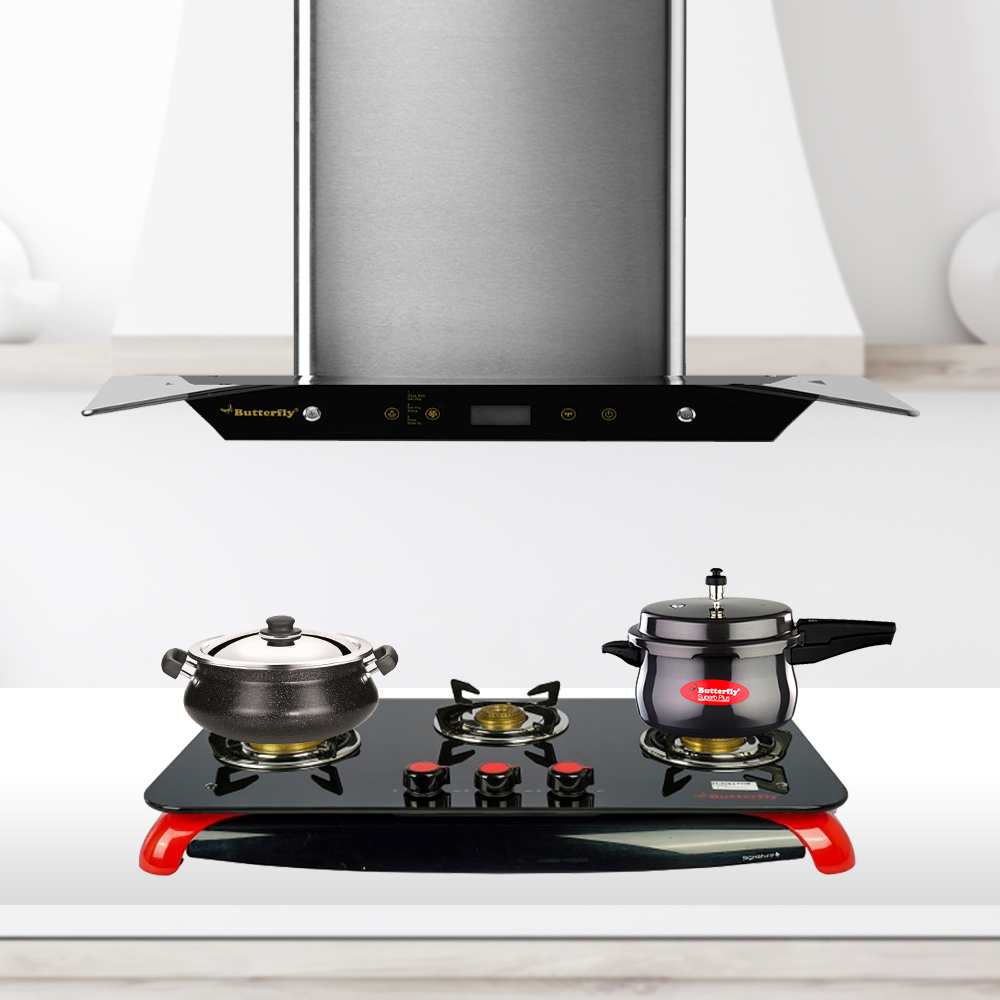
The gas stove — the category Butterfly helped define.
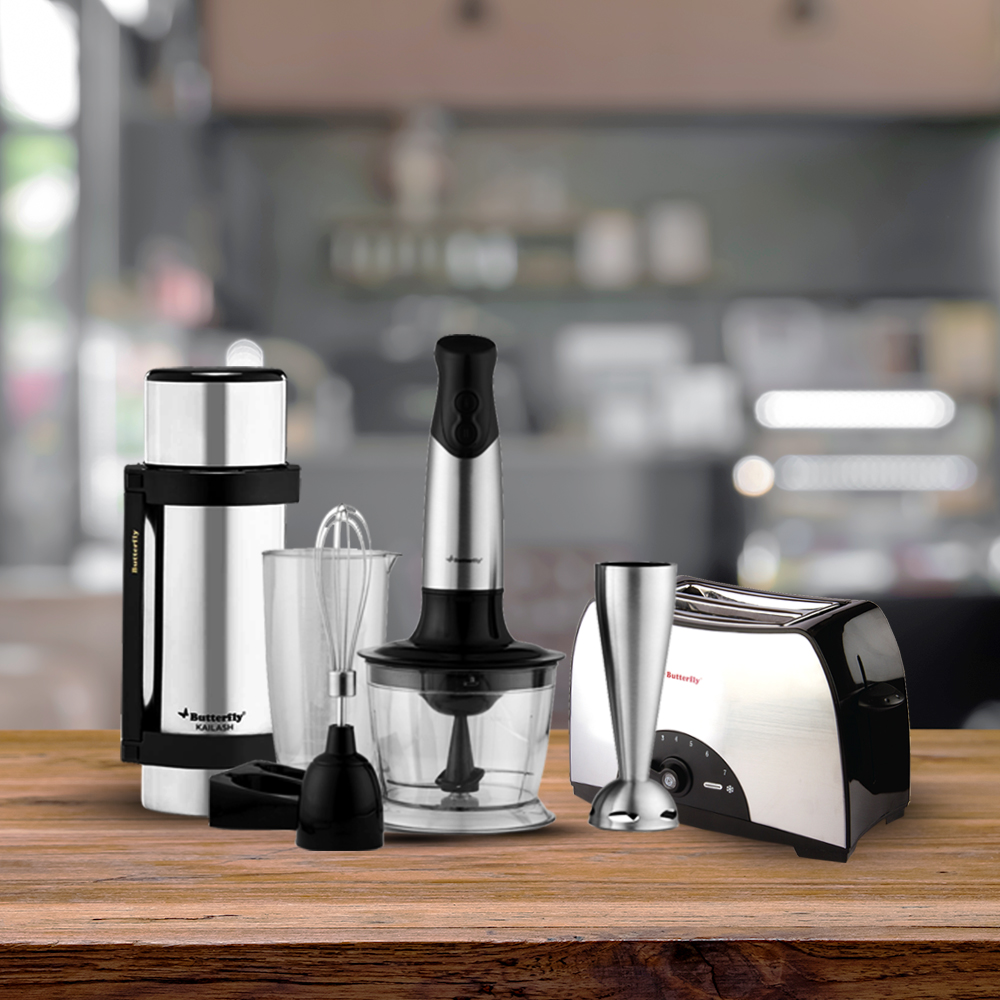
Breakfast and lifestyle appliances for the urban Indian home.
Awards and Recognitions
The case for Butterfly’s quality credentials does not rest on marketing claims; it rests on a series of external validations accumulated over decades. Being the first Indian company to introduce stainless steel pressure cookers and vacuum flasks was not simply a commercial first — it required demonstrating that stainless steel could perform reliably in high-pressure, high-temperature cooking environments, which demanded real engineering rigor. The first ISO 9001 certification in the kitchen appliances category followed, setting a standard that competitors would later have to meet. In 2005, the Green Label certification for thermal efficiency in LPG stoves recognized something that Butterfly’s engineers had prioritized long before energy efficiency became a fashionable concern. The National Award for Quality Product from the Ministry of MSME in 2010 validated the company at the national level. In January 2024, the Bureau of Indian Standards issued a Certificate of Appreciation — a recognition that the company’s quality systems remain current, not just historical. The CRISIL AA/Stable and A1 credit ratings reflect financial discipline alongside product quality, and the Quality Award from the Government of Tamil Nadu adds a regional institutional endorsement to the picture. Taken together, these recognitions describe a company that has maintained quality standards across seven decades and multiple product categories — which is harder than it sounds.
Leading Marketing Campaigns
Butterfly’s approach to marketing has always been unconventional by national brand standards, and largely by necessity. The company did not grow up with the advertising budgets of Philips or Prestige. It grew up in South India, competing in a market where trust was built through community networks, hardware stores, and the recommendations of neighbors who had owned a Butterfly pressure cooker for fifteen years.
The Tamil Nadu government welfare distribution programmes were, in retrospect, the most powerful marketing vehicle Butterfly ever had — and it did not choose them strategically so much as earn them through credibility and scale. When millions of families across Tamil Nadu received government-distributed kitchen appliances, and those appliances bore the Butterfly name, the brand was effectively being introduced in the most trusted possible way: through an institutional endorsement. The recognition that created could not be bought. It simply came with being good enough to win the contract.
More recently, Butterfly’s marketing has shifted toward digital channels, influencer partnerships, and social media, tracking the migration of Indian consumers from television to mobile screens. Advertising spend reached ₹65 crore in FY2020, approximately ten percent of revenue at the time — a significant commitment. Online revenue’s jump from ₹45 crore in FY2019 to ₹145 crore in FY2020, a 220 percent increase in a single year, confirmed that the digital pivot was not merely aspirational. Post-Crompton, the distribution strategy has been amplified by access to Crompton’s 4,000-plus strong premium dealer network, which gives Butterfly something it previously lacked: a credible pathway into markets where it has historically been invisible.
The Turning Points
Every company has moments that define it more than all the ordinary years combined. Butterfly has had three.
The first was the Tamil Nadu government order of 2011. The ₹285 crore order, followed by the ₹460 crore order in 2012, was transformational in scale — and dangerous in everything it implied. When a single customer accounts for the majority of your revenue, you stop being a consumer brand and start being a contractor. The operational decisions, the factory capacity, the workforce planning — all of it gets calibrated to that one customer. And when that customer changes its procurement priorities, as governments reliably do, you are left with infrastructure and costs built for a world that no longer exists.
The second was the 2017 net loss. It was not simply a bad year. It was a reckoning. The government orders had disappeared. Demonetisation had frozen consumer spending. Butterfly was forced to ask, honestly, whether it was a real consumer brand or a government supplier dressed in consumer brand clothes. The answer, and the rebuilding that followed, was uncomfortable and necessary. The company that emerged from 2017 was more focused on earned consumer loyalty than on contracted volume — a harder path, but a more durable one.
The third was the 2022 Crompton acquisition. This was the end of family majority ownership and the beginning of something genuinely new. Crompton did not acquire Butterfly because it wanted a regional brand to sit comfortably in its portfolio. It acquired Butterfly because it saw a platform for national kitchen appliance dominance, and the stated target — becoming a top-two pan-India kitchen appliance brand by 2027 — is ambitious in a way that no family management team, operating within its capital constraints, could have credibly pursued. Whether Butterfly achieves that target remains to be seen. But the ambition itself marks a categorical change in what the company is trying to be.
When a single customer accounts for the majority of your revenue, you stop being a consumer brand and start being a contractor.
Branches and Distribution
The infrastructure that Butterfly has built over seven decades is not glamorous, but it is real. The company operates out of its headquarters in Chennai and four manufacturing units in Tamil Nadu at Navalur, where in-house design, die-making, and research and development capabilities have allowed Butterfly to control its product development in ways that pure assembly operations cannot. Seventeen branches across India provide the management layer for a distribution network of 550-plus distributors and 25,000-plus retail points — the kind of reach that national brands take decades to build and that new entrants cannot replicate quickly.
The export presence — United Kingdom, Canada, Australia, Japan, the Middle East, the United States, Mauritius, Sri Lanka, and the UAE — serves the South Indian diaspora, which is exactly the right target for a brand whose identity is so closely tied to a specific regional cuisine. Institutional channels through CSD, CPC, and TNPC canteen stores, added since 2018, diversify the customer base beyond retail. The tie-ups with BPCL, Indian Oil, and HPCL for gas dealer channels are particularly smart distribution engineering: gas dealers already have a relationship with the households that need gas stoves and the products that use them. Selling through them is not just channel efficiency; it is category logic.
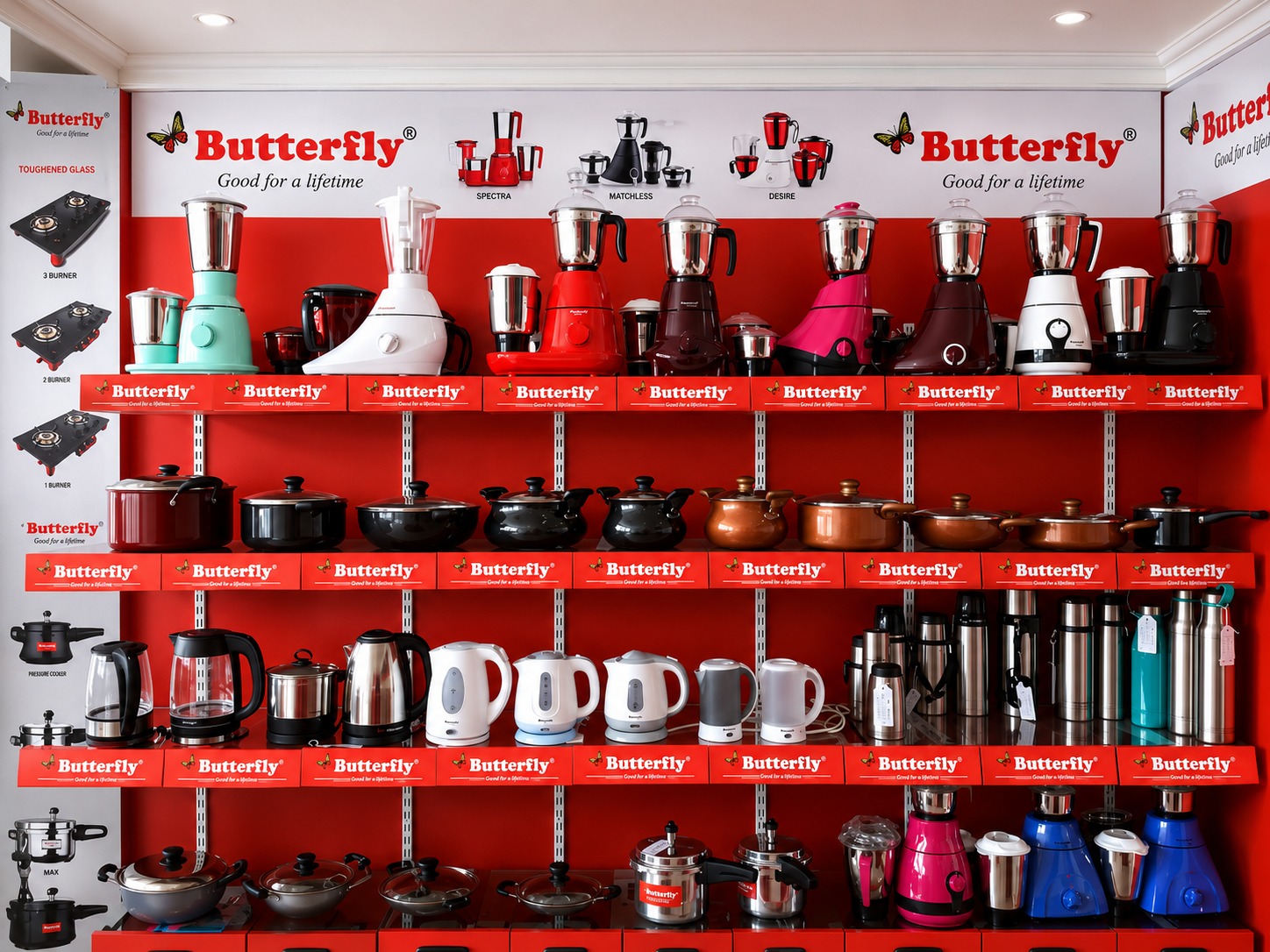
25,000-plus retail points — the kind of reach national brands take decades to build.
Achievements and Current Standing
Where Butterfly stands in 2025 is the product of every decision, every mistake, and every reconstruction described above. Revenue of ₹943 crore in FY2025-26. A market capitalisation of ₹1,163 crore. Nineteen patents. Eleven hundred and seventy-one employees. Twenty-five thousand-plus retail points across India. A CRISIL AA/Stable credit rating that reflects a financially disciplined operation. The number one position in stainless steel LPG stoves in South India. Number two in mixer grinders and pressure cookers in the same region. Exports to over ten countries. And a 2027 target — set by a majority shareholder with the distribution network to make it credible — of becoming a top-two pan-India kitchen appliance brand.
Whether that target is achieved or not, it is worth pausing on what Butterfly already represents. It is a Tamil Nadu company, built on a contrarian bet about stainless steel made by a metal merchant in Coimbatore in the 1950s, that survived government dependency, demonetisation, and COVID to emerge as a nationally relevant consumer brand. It did this not through disruption or innovation theatre, but through seventy years of making things that worked for the kitchens of ordinary Indian families. That is a harder thing to replicate than any technology advantage. It is, in the truest sense, earned.
Butterfly Gandhimathi Appliances today stands as one of the most compelling success stories to emerge from India’s consumer manufacturing sector. From a modest stainless-steel tumbler crafted in Coimbatore during the 1950s to a kitchen appliance company generating ₹943 crore in annual revenue and serving millions of households, its journey reflects the power of vision, persistence, and an unwavering understanding of the Indian consumer. Few brands have managed to remain relevant across seven decades of economic change, technological disruption, shifting consumer aspirations, and intensifying competition. Butterfly has done so not by chasing trends, but by consistently solving everyday problems for ordinary families.
The company’s evolution has not been without challenges. It has experienced the risks of overdependence on government contracts, navigated periods of financial stress, endured the shocks of demonetisation and the pandemic, and undergone the profound transition from a family-controlled enterprise to a professionally governed company backed by a national consumer-electricals giant. Yet each challenge has strengthened rather than diminished the brand. The acquisition by Crompton Greaves Consumer Electricals has opened a new chapter, giving Butterfly the scale, distribution reach, and strategic resources required to compete far beyond its traditional strongholds in South India. As it pursues its ambition of becoming one of India’s top two kitchen appliance brands by 2027, Butterfly carries with it more than a portfolio of products and a growing market share. It carries a legacy built on trust, quality, and an intimate understanding of Indian kitchens. In many ways, Butterfly represents the best of Indian enterprise—a company born from a regional opportunity, nurtured by family values, strengthened through adversity, and now poised for national prominence. Its story is ultimately not just about appliances or business growth. It is a story of Indian manufacturing at its most enduring: practical, resilient, innovative, and deeply connected to the lives of the people it serves.