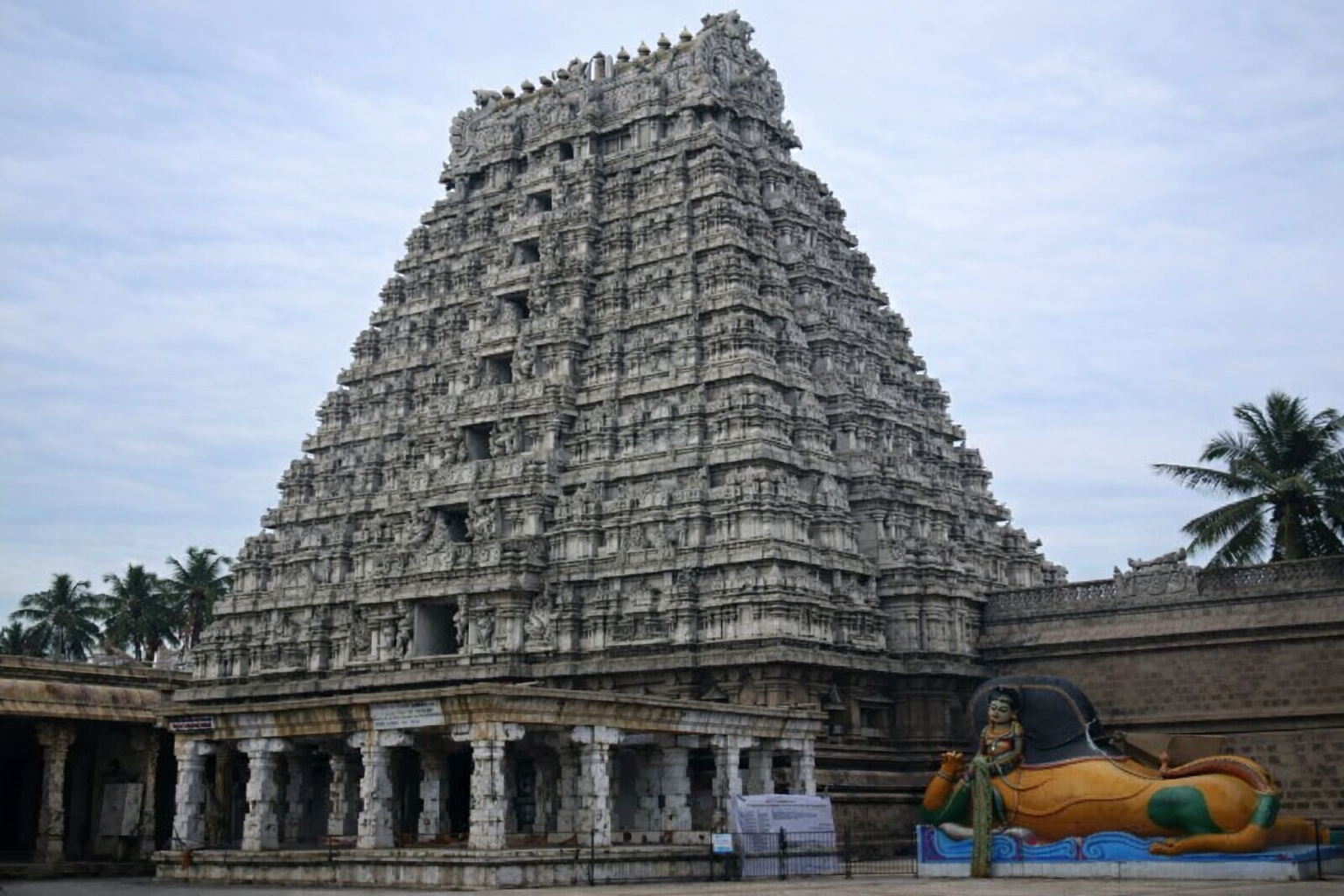
Historical Significance
The origins of the Margabandeswarar Temple date back to the 13th century during the Rashtrakuta dynasty. The principal shrine was initially established by Raja Raja Chola, the Viceroy Sambara Rayan, and under the patronage of Kulothunga Chola. Over successive centuries, the temple witnessed contributions and enhancements by the Pallavas, Hoysalas, and Vijayanagara kings, each leaving an indelible mark on its architectural and artistic development. The Vijayanagara Nayaka rulers were particularly influential in constructing the majestic Rajagopuram (main tower), the Artha Mandapam, and the Maha Mandapam, augmenting the temple’s grandeur. The temple holds additional historical and cultural significance as the birthplace of Sri Appayya Dikshitar, a celebrated philosopher of the Advaita tradition who followed the teachings of Adi Shankaracharya. His connection to the temple underscores the site’s importance not only as a center of worship but also as a hub of spiritual learning and philosophical discourse. Through centuries, Margabandeswarar Temple has remained a symbol of devotion, art, and religious scholarship, reflecting the enduring legacy of South Indian temple culture.
Mythology and Legends
The temple is steeped in rich mythology that enhances its spiritual aura. According to legend, a dispute arose between Lord Brahma and Lord Vishnu regarding their respective roles in the cosmic order. Seeking resolution, they approached Lord Shiva, who manifested as an infinite lingam, challenging them to find his beginning and end. Lord Vishnu, assuming the form of a boar, could not locate Shiva’s end and conceded defeat. Lord Brahma, attempting deceit, failed to find Shiva’s beginning even after ascending to the heavens disguised as a swan, and he sought the testimony of the ketaki flower that adorned Shiva’s head. Enraged by this deception, Lord Shiva cursed Brahma, who was then reborn as a Brahmin named Siva Sharma in Virinjipuram. This devotee endured numerous hardships but continued his penance and worship at the temple. Pleased with his devotion, Lord Shiva ultimately appeared before him, alleviating his suffering and granting blessings. This narrative has imbued the temple with a reputation as a site where unwavering faith can overcome adversity, attracting devotees seeking divine guidance and blessings for their personal and spiritual challenges. The association of Lord Brahma as Virinjan, a form that worshipped Shiva at this site, contributes to the temple’s alternate name, Virinjipuram.
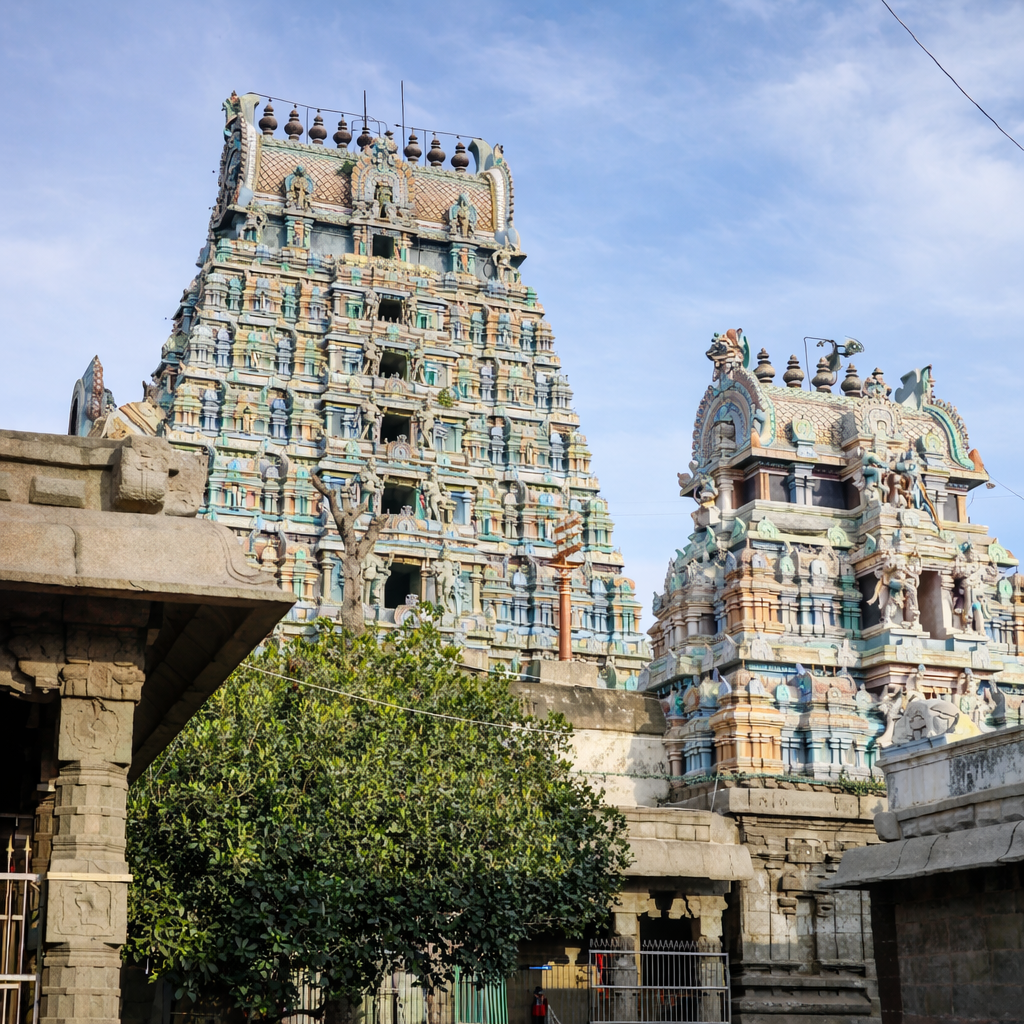
Intricately sculpted and painted tower shrines
Architectural Marvel
Margabandeswarar Temple exemplifies the Dravidian style of temple architecture, featuring five prakarams (enclosure walls), multiple gopurams (towering gateways), and intricately designed mantapas (pillared halls). The east-facing Rajagopuram, standing seven stories tall and reaching a height of 110 feet, dominates the temple landscape, visible from afar as a symbol of divine presence and artistic mastery. The two Kalyana Mandapas on either side of the outer enclosures are adorned with exquisitely carved pillars and sculptures depicting an array of deities, celestial beings, and mythological narratives. Among the notable sculptures are Narasimha emerging to vanquish Hiranyakasipa, Vishnu portrayed with musical instruments, and intricate depictions of Shiva in various divine forms.
At the heart of the temple lies the sanctum sanctorum housing the presiding deity, Lord Margabandeswarar, represented as a Shiva lingam slightly tilted towards the northeast. During Panguni, sunlight illuminates the deity, creating a celestial spectacle that draws devotees and pilgrims from across the state. The sanctum’s ceiling is adorned with Rudraksha beads, enhancing its sacred ambiance. The consort goddess, Maragadambal, and other deities such as Ganapathy, Subramanya, Chandra Mouleeswara, Pancha Mukha Lingam, Saptha Matrukas, Lakshmi, Saraswathi, and Durga, are also enshrined within the temple complex. A unique feature of the temple is the Simha Teerth, a sacred water tank distinguished by a lion-faced sculpture, and the Sthala Vruksha, a palm tree with reputed miraculous powers. The temple also contains a natural sundial system, historically used to tell time by tracking the movement of sunlight and shadows, demonstrating the intersection of science, spirituality, and architecture.
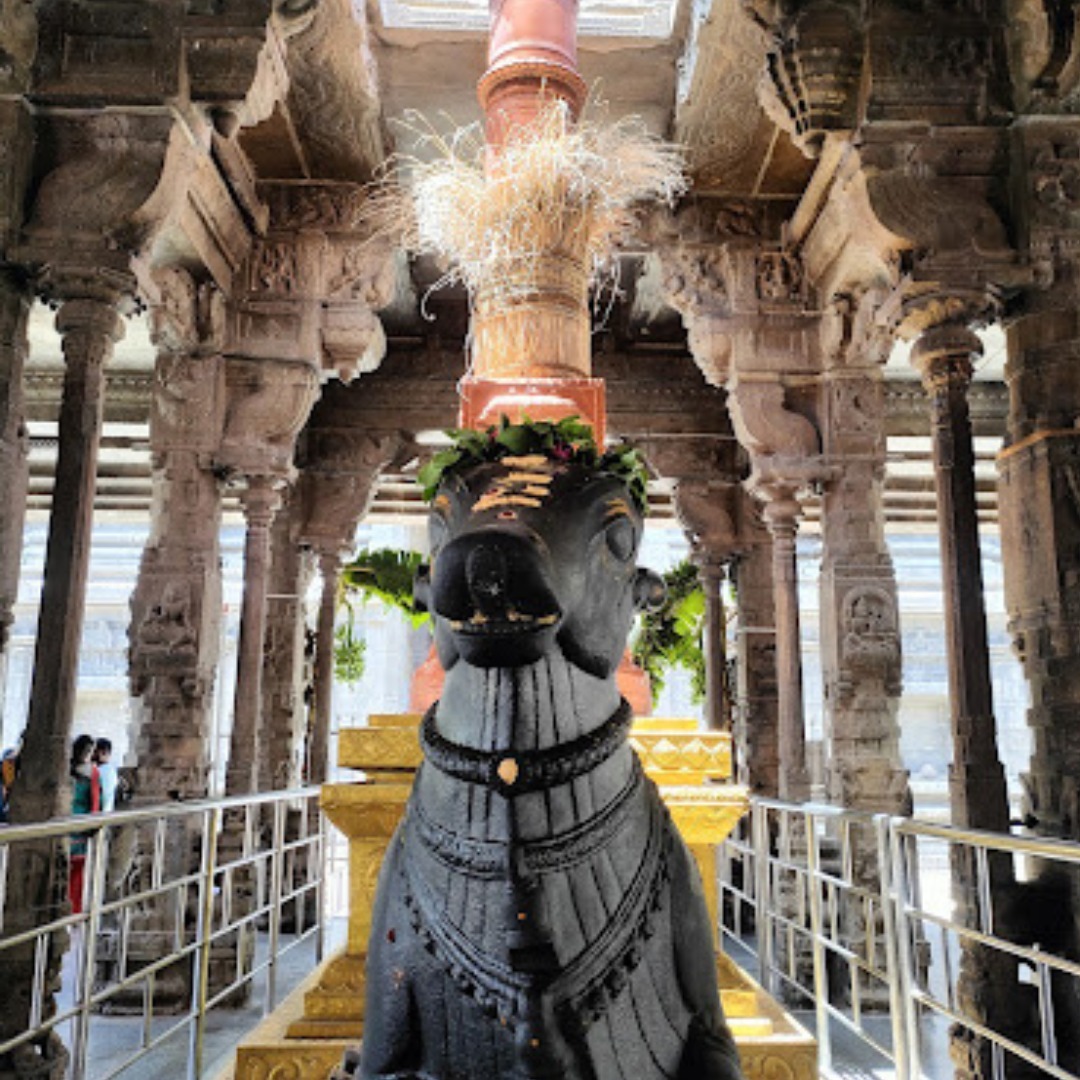
The Nandi, seated before the sanctum
Festivals and Celebrations
The temple celebrates several major festivals, which are vital to its religious and cultural identity. The ten-day Theerthavari festival during Panguni (March–April) marks the period when sunlight falls directly on the Shiva lingam, drawing crowds of devotees for elaborate rituals, processions, and ceremonial bathing of the deity. Maha Shivaratri, celebrated in February or March, is observed with night-long vigils, chanting, music, and dances honoring Lord Shiva. Navarathri, in September–October, is another key festival where the temple comes alive with vibrant decorations, cultural performances, and devotional fervor. These festivals reinforce the temple’s role as a center of communal worship, cultural expression, and spiritual continuity.
Visiting the Temple: Timings, Dress Code, and Accessibility
Margabandeswarar Temple welcomes visitors from early morning until evening, with daily timings from 6:00 AM to 12:00 PM and 4:00 PM to 8:00 PM. While general entry is free, devotees may opt for a special darshan at a nominal fee of Rs. 10. Visitors are encouraged to dress modestly and respectfully, with men wearing dhoti, pajama, or formal trousers paired with a shirt, and women donning sarees, half sarees, or churidhar. Short dresses, sleeveless tops, and nightwear are discouraged to maintain sanctity. Non-Hindus are allowed to explore the temple complex, although access to the sanctum sanctorum may be restricted. The optimal time to visit Margabandeswarar Temple is during the winter months from November to February when the weather is mild and conducive for exploring the expansive complex. A visit during Panguni provides a unique experience of observing the sunlight fall directly upon the lingam, coinciding with the Theerthavari festival and other major rituals.
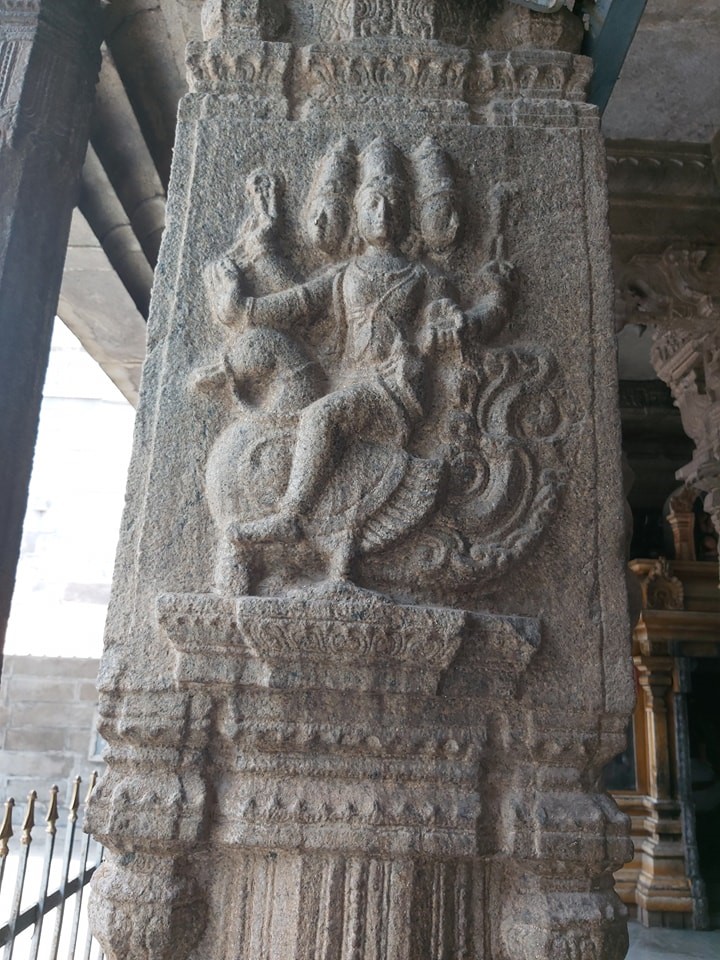
Stone pillars carved with divine figures
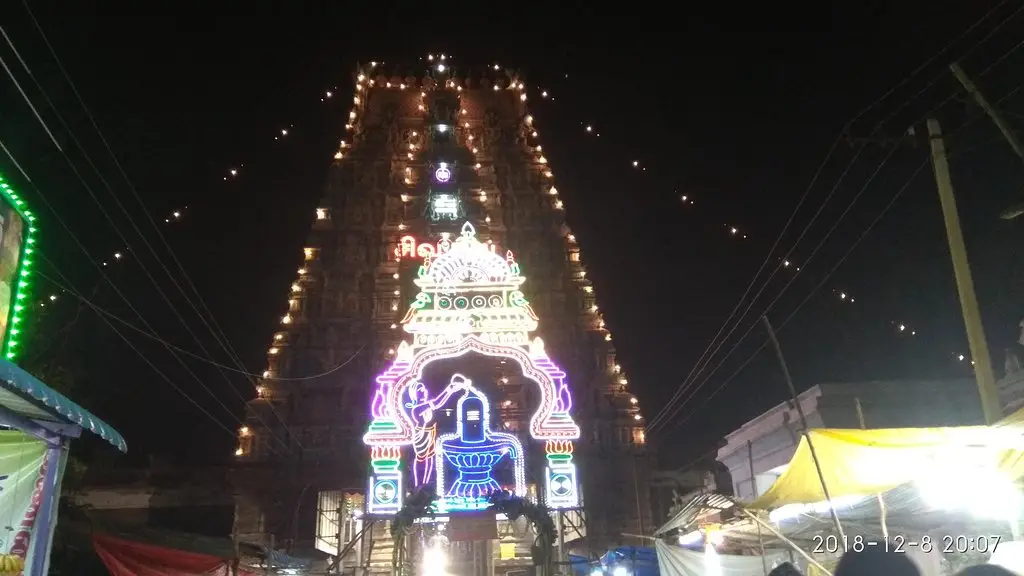
The temple aglow during a festival night
How to Reach Margabandeswarar Temple
The temple is well-connected by road and rail. Vellore, located just 13 kilometers away, serves as the nearest city with robust transport links, including buses, trains, and taxis. Chennai International Airport, approximately 138 kilometers from the temple, provides access for domestic and international travelers. From Vellore, visitors can easily hire auto-rickshaws, taxis, or private vehicles to reach the temple along the Vaniyambadi Road. The proximity to Vellore and its accessibility from major South Indian cities makes Margabandeswarar Temple a convenient destination for pilgrims, tourists, and cultural enthusiasts alike.
Cultural and Heritage Importance
Margabandeswarar Temple is not only a place of worship but also an important cultural heritage site, reflecting the rich tapestry of South Indian temple architecture, ritual practice, and community life. Its carvings, gopurams, mandapas, and sundial system offer a glimpse into the sophisticated artistry, engineering, and devotion of the Cholas, Pallavas, Hoysalas, and Vijayanagara kings. The temple continues to serve as a living center of spirituality, where centuries-old legends, philosophical traditions, and artistic expression coexist with contemporary religious practice.
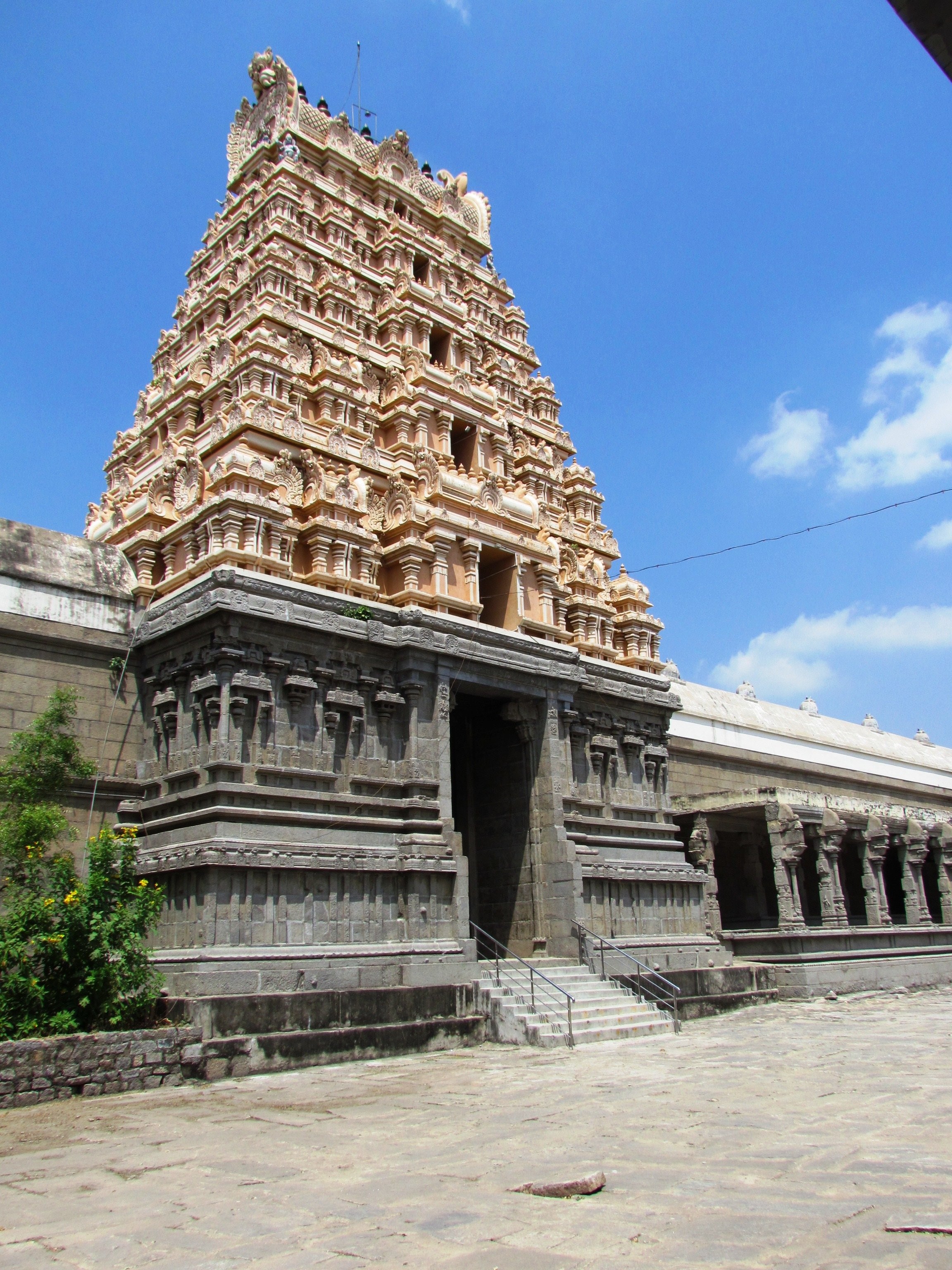
Weathered granite halls that have stood for centuries
In preserving Margabandeswarar Temple, the Archaeological Survey of India has recognized the temple as a monument of national importance, safeguarding its structures, sculptures, and sacred spaces. The temple stands as a beacon of South Indian heritage, offering an immersive experience for those seeking to explore the convergence of faith, history, and artistry.